OSU wheat variety trial results available online
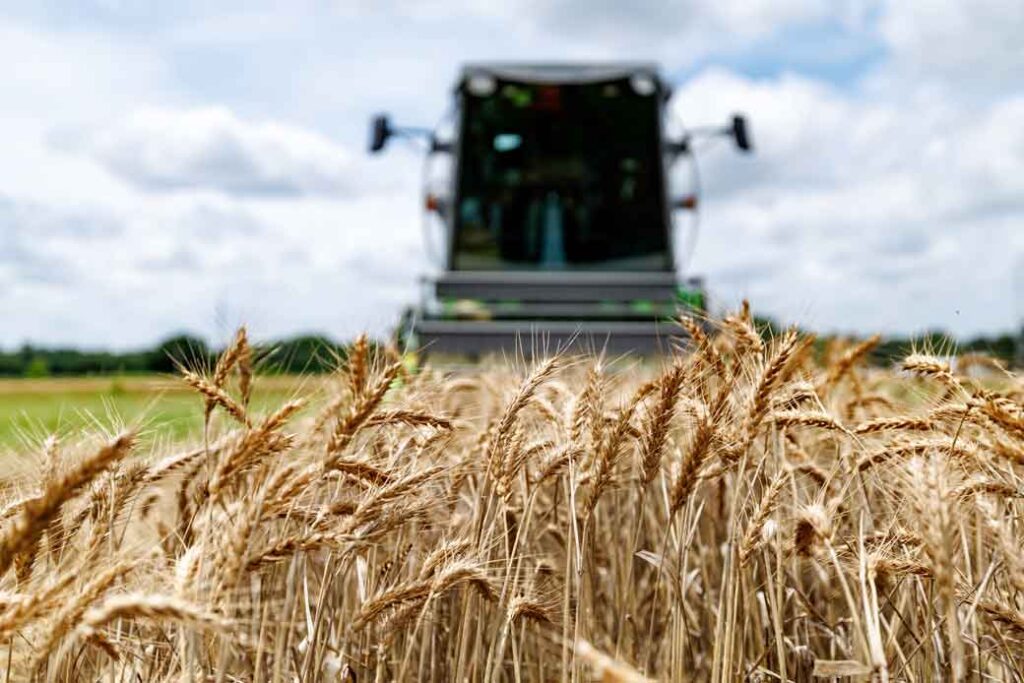
The Small Grains OSU Extension Team harvests demonstration plots at the Agronomy Research Station in Stillwater to evaluate varieties for performance. (Photo by Mitchell Alcala, OSU Agriculture)
OSU wheat variety trial results available online
By Baylee Smith
STILLWATER, Okla. – Oklahoma State University annually conducts wheat variety trials across the state to show how different varieties respond to local growing conditions. Information from each unique site provides farmers with detailed information to make sound planting decisions for their operations.
The 2026 trial results are in progress, and the latest wheat harvest results are available online.
“Each year, we test between 20 and 55 cultivars at around 20 field experiments to deliver timely information to producers on available wheat cultivars that might be well-adapted to Oklahoma,” said Jayson Lusk, vice president and dean of OSU Agriculture. “This program, funded by the Oklahoma Wheat Commission and the Oklahoma Wheat Research Foundation, allows producers to choose the best wheat variety for the highest impact on profit.”
The trials include multiple production systems, such as standard, intensive, grain-only and dual-purpose management.
Throughout the trials, researchers collect data on traits including yield, protein concentration, disease resistance, plant height, maturity and other agronomic characteristics that become evident throughout the growing season, said Amanda Silva, OSU Extension small grains specialist.
This comprehensive approach allows producers to select varieties based on a wider variety of factors.
This year’s producers navigated a challenging season with a prolonged drought, warm winter and early spring, Silva said. Challenges like these provide opportunities to observe differences in resilience among varieties.
“Years like this help us separate varieties that are broadly adapted and resilient from those that perform well only under favorable conditions,” she said. “No single year tells the whole story. Multi-year data help growers identify varieties that can consistently perform well across a wide range of environments rather than those that excel only in a specific season.”
A new tool developed this year is the Wheat Phenotyping Cart, a field-based platform equipped with multiple sensors to rapidly collect detailed measurements from wheat plots. The cart was developed through a collaboration between the OSU Wheat Improvement Team, the OSU Crop Physiology and Small Grains Extension program led by Silva and Ning Wang and her team in the OSU Department of Biosystems and Agricultural Engineering.
This collaboration represents an important step toward building an interdisciplinary phenotyping program at OSU, bringing together expertise in plant science, engineering and data analytics to expand the university’s capacity for high-throughput crop phenotyping, Silva said.
“The cart combines several advanced sensing technologies, including cameras, crop reflectance sensors, canopy temperature sensors and GPS,” she said. “The goal is to generate objective, high-throughput measurements that complement traditional field observations and accelerate variety evaluation and improvement efforts.
The OSU wheat variety performance tests continue to be valuable decision-making tools for wheat producers in Oklahoma and surrounding states, providing independent, unbiased information on variety performance across a wide range of environments and management systems.
More than 70% of all wheat acres in Oklahoma are planted with varieties developed at OSU, including 43 varieties commercialized by the OSU Wheat Improvement Team since 2000.
As wheat is the No. 1 crop in Oklahoma and accounts for 20% of human calorie intake, wheat research helps OSU Agriculture serve key constituents and lead in areas of comparative advantage in the wheat industry.
To continue to impact the wheat industry, OSU Agriculture is creating the Agronomy Discovery Center as part of the Agronomy Research Station to modernize the facilities. Plans include creating a new headhouse, research greenhouse and a multipurpose classroom and lab building.
OSU Agriculture is dedicated to improving the quality of life of Oklahomans through science-based information and education. It is comprised of the Ferguson College of Agriculture and two state agencies: OSU Ag Research and OSU Extension.
MEDIA CONTACT: Mandy Gross | Office of Communications & Marketing, OSU Agriculture | 405-744-4063 | ma*********@*****te.edu
READ MORE
Economic & Social Impact of the HOME Program Across Oklahoma